
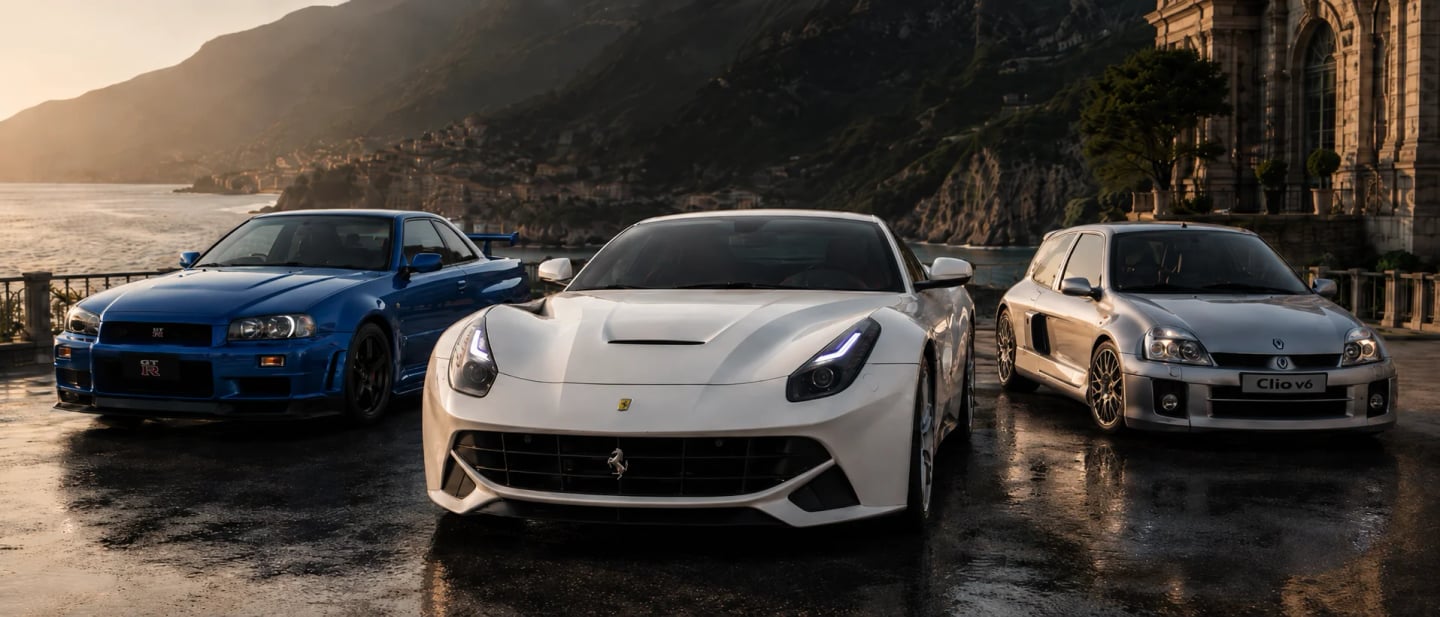
The car market has always had a weakness for stories. Some cars become valuable because they are rare, some because they are objectively good, and some because an entire generation decides that a certain model represents a moment in time. The most interesting cars usually sit somewhere between those categories. They are not always the fastest, the most usable or the most technically perfect, but they have a combination of character, timing and cultural relevance that makes the market keep coming back to them.
In this first edition of Octane Spot, we look at three very different cars that all raise the same question: is the current market still rational, or has the future-classic story already been fully priced in? The Nissan Skyline R34 GT-R, Renault Clio V6 and Ferrari F12berlinetta each have a strong enthusiast following, but they appeal to very different buyers. One is a JDM icon that became a global cultural object, one is a deeply irrational Renault Sport experiment, and one is a modern front-engined V12 Ferrari that may come to represent the end of an era.
The pricing mentioned below should be read as a broad market snapshot rather than a fixed valuation. Asking prices move quickly, and the difference between an average example and the right example can be substantial. Still, the current ranges tell us something useful about how the market is already thinking about these cars.
Nissan Skyline R34 GT-R: the icon is real, but so is the pricing
The R34 GT-R may be one of the clearest examples of a car whose value is now driven as much by culture as by engineering. The fundamentals are strong: the RB26 engine, manual gearbox, four-wheel-drive system, tuning potential and relatively limited production numbers all give the car a serious technical foundation. But that alone does not explain where the market has gone. The R34 became something larger through Gran Turismo, Fast & Furious, JDM forums, import culture and years of online mythology. For many buyers, it is not simply a Nissan. It is the car they wanted before they even understood the collector market.
That emotional demand is now clearly reflected in European pricing. Genuine R34 GT-Rs are no longer sitting in the “interesting alternative” category. Good cars often sit well above €150,000, while special versions, rare colours, low-mileage examples or particularly original cars can move toward €250,000 to €300,000 and beyond. It is important to separate those cars from non-GT-R R34 variants, because the market treats them very differently.
Our view is that the R34 GT-R is absolutely a real future classic, but it is no longer an undiscovered one. The market has already understood the story, which means the margin for error has become much smaller. At today’s levels, buying the wrong car can be expensive. Authenticity, version, originality, import history, maintenance records and modifications matter much more than they did when the car was still a relatively affordable enthusiast choice.
A truly good R34 GT-R will likely remain desirable for a long time, because the demand behind it is global and generational. But we would not call it the most attractive risk/reward proposition of the three cars here. The car is iconic, but the price already reflects that status. In other words: buy the R34 because you genuinely want the R34, not because you think the market has somehow failed to notice it.
Renault Clio V6: irrational, flawed and still extremely compelling
The Renault Clio V6 is almost the opposite of a rational market proposition, which is exactly why it remains so interesting. Renault took what was supposed to be a compact hatchback and removed the basic things that make a hatchback useful. The rear seats disappeared, a V6 was placed behind the front occupants, the bodywork became wider and more aggressive, and the result was a strange mid-engined, rear-wheel-drive machine wearing the face of a small French car.
That concept feels almost impossible today. Modern manufacturers may still build fast hatchbacks, but very few would approve something this odd as a production car. The Clio V6 is not loved because it is the best hot hatch, because it is not. It is not loved because it is the most polished sports car, because it is not that either. Its appeal comes from the fact that it does not fit neatly into any category. It is part Renault Sport, part concept car, part homologation fantasy and part collector-market conversation piece.
Current European asking prices generally seem to sit around €55,000 to €80,000, depending heavily on phase, mileage, condition, history, originality and colour. On paper, that is a lot of money for a Clio. In reality, that is not the right way to judge it. The Clio V6 should not be compared with a normal hot hatch. It should be judged as a limited-production, mid-engined Renault Sport product from a period when major manufacturers were still willing to build genuinely strange cars.
Our view is that the Clio V6 is no longer cheap, but still makes sense in the right specification. A poor or heavily compromised example may be difficult to sell, because the buyer pool is relatively specific. This is not a 911, where there is always a broad base of buyers waiting. The Clio V6 needs the right enthusiast, and that enthusiast will care about originality, history and condition. A strong Phase 2 probably has the clearest commercial appeal, while a Phase 1 may attract buyers who prefer the more raw and slightly more unhinged character.
The reason we still like the car is simple: it is unlikely to be repeated. That matters. In a market where many performance cars are becoming heavier, more digital and more similar in character, the Clio V6 feels like a product from a more experimental era. It is not the safest buy of the three, but it may be the one with the most personality per euro.
Ferrari F12berlinetta: the strongest long-term case
The Ferrari F12berlinetta is the most conventional car in this comparison, but probably the strongest long-term case. It does not rely on internet nostalgia in the way the R34 does, and it is not a charming oddity like the Clio V6. Its appeal is easier to explain: a naturally aspirated V12, mounted in the front, wrapped in a beautiful modern Ferrari body, with enough performance to still feel serious today.
The F12 sits in an interesting position in the Ferrari market. It is modern enough to be usable, but old-school enough to feel increasingly special. As Ferrari continues to move further into turbocharging, hybrid systems and electrification, the simplicity of the F12’s emotional appeal becomes more important. A large naturally aspirated V12 Ferrari without hybrid complexity is not just an engine configuration. It is a selling point that becomes easier to appreciate with time.
In the current European market, normal F12berlinettas appear to sit roughly around €210,000 to €310,000, depending on mileage, colour, options, ownership history, maintenance, accident history and VAT status. The F12tdf should be treated separately, because that is a different collector category entirely. For the standard F12berlinetta, the interesting question is not whether it is cheap. It is not. The question is whether it is still relatively logical compared with what it represents.
Our view is that the F12 is the strongest of these three as a long-term modern classic. It has the brand, the engine, the design, the performance and the historical positioning. Unlike the R34, its case is not mainly dependent on one generation’s nostalgia. Unlike the Clio V6, it does not require buyers to accept a large amount of irrationality. It is simply a great Ferrari from a type of Ferrari that is becoming harder to replace.
That does not mean every F12 is a good buy. The spread between an average car and the right car can be meaningful. Colour, options, mileage and history matter, and buyers should be careful with cars that appear cheap for a reason. But if bought correctly, the F12 has one of the cleaner future-classic arguments in the modern Ferrari market.
Our view
If the question is pure emotion, the R34 GT-R is difficult to beat. It is one of the defining enthusiast cars of its generation, and its cultural relevance is not going away. The problem is that the market already knows this. There may still be long-term strength in the best examples, but the car no longer feels like a hidden opportunity.
If the question is character, the Clio V6 is the most entertaining. It is strange, rare, flawed and memorable, which is often exactly what creates long-term enthusiast demand. We would not call it the safest buy, but we would call it one of the most interesting cars in its price range when the example is right.
If the question is the strongest overall case, our choice is the Ferrari F12berlinetta. It offers the most convincing mix of brand strength, mechanical significance, usability and long-term collectability. It is not cheap, but it is logical. In a market where many cars are expensive mainly because they are fashionable, the F12 has a deeper argument behind it.
Our ranking would therefore be:
- Ferrari F12berlinetta
- Renault Clio V6
- Nissan Skyline R34 GT-R
That ranking is not a judgement of which car is the coolest. Many enthusiasts would understandably put the R34 first on emotion alone. But from a market perspective, we think the F12 currently offers the strongest future-classic case, the Clio V6 remains the most characterful outsider, and the R34 GT-R is the brilliant icon whose story has already been largely priced in.
The more interesting question is where the market goes from here. Will V12 Ferraris continue to separate themselves from the rest of the modern performance market? Will strange analogue cars like the Clio V6 become even more desirable as manufacturers stop taking those risks? Or will JDM icons like the R34 keep proving that cultural relevance can be just as powerful as traditional collector logic?
Our ranking is clear, but it is far from the only possible answer. Many enthusiasts would put the R34 first, others may see the Clio V6 as the most interesting long-term bet, and some will argue the F12 is already too expensive to offer real upside.
So we are curious: which of these three would you choose today, and which one do you think the market is getting wrong?
Would you rank the Ferrari F12berlinetta, Renault Clio V6 and Nissan Skyline R34 GT-R differently?